I Ching Hexagram 63 (After Completion): Meaning in Love, Career and Life
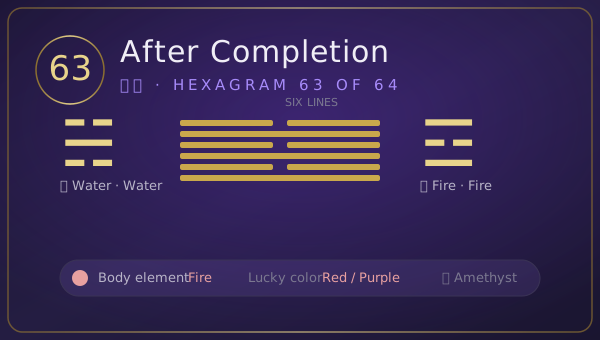
Hexagram 63 is the after-completion hexagram of the I Ching: water above, fire below — the two elements finally working together, each doing the job it was made for. Its classical judgment reads "success in small things; beneficial for perseverance; good fortune at the beginning, disorder at the end" (既济:亨小,利贞。初吉终乱), and its image is water over fire, which the text says means the noble person "thinks of dangers and prepares against them in advance." When Hexagram 63 appears in a reading, it marks a completed state — the crossing done, the job finished — and the hexagram's entire purpose is to warn about what happens to finished things.
The Story of Hexagram 63: The Cauldron That Finally Worked
Water over fire is the one arrangement in nature where the two elements cooperate: fire below boils water above, and everything humans have ever cooked, cleaned, or forged began with that exact stack. The I Ching's 63rd hexagram is that arrangement — the elements in their correct positions, each doing its own job, the system functioning. But the hexagram's judgment contains the most sobering sentence in the Book of Changes: 初吉终乱 — "good fortune at the beginning, disorder at the end." The hexagram's own text knows what completion actually is: not a destination, but the moment maintenance becomes the whole task. Its image text spells out the strategy — 思患而豫防之, "think of what could go wrong and prepare for it beforehand" — because a working system that stops being watched is a system already failing.
What Is Hexagram 63?
- Name: 既济 (Jiji), traditionally rendered After Completion; also translated as Already Fulfilled, Completion, or Already Crossed
- Structure: Water over Fire — every line in its correct position, yin where yin belongs and yang where yang belongs
- Position: 63 of 64, the second-to-last hexagram, the state just before the cycle resets into Hexagram 64 (Before Completion)
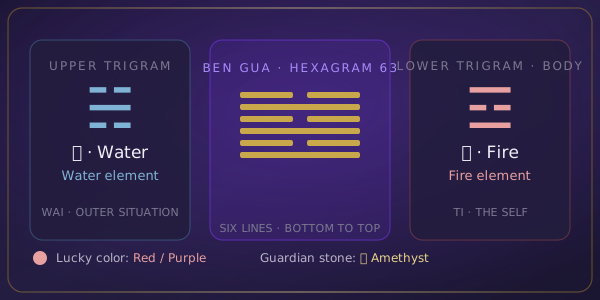
- Element: Fire on the body trigram — the lower trigram (fire) belongs to Fire; water above belongs to Water
- Body trigram: the lower trigram (fire), which in plum blossom divination represents the self
- Core images: water over fire, the crossed river, the finished work, the boat that needs patching, the sacrifice done right
The Core Meaning of Hexagram 63
The classical judgment of Hexagram 63 reads: 既济:亨小,利贞。初吉终乱 — "Success in small things. Beneficial for perseverance. Good fortune at the beginning, disorder at the end." That final clause is the hexagram's signature: completion is real, and completion is the beginning of a different problem.
Three things this hexagram is telling you, each standing on its own:
Completion is a state that requires maintenance, not achievement. Every line of Hexagram 63 is in its correct place — the only hexagram in the Book of Changes where that is true. The system works. And that is exactly why the hexagram's judgment warns about the end: working systems are abandoned by attention. The hexagram's image text is the entire manual — think of the danger in advance, prepare in advance (思患而豫防之).
Success after completion is small, and that is the point. 亨小 — "success in small things" — is an unusual judgment. The big movement is over; what remains is the small maintenance that keeps the finished thing finished. The hexagram rewards the person who keeps patching the boat (line 4), not the person who is still looking for a victory.
The end is built into the beginning. 初吉终乱 is not pessimism; it is the hexagram's structural claim. A completed state is at maximum order, and maximum order is the point from which disorder is the only direction available. The hexagram that follows — 64, Before Completion — is not a punishment; it is the cycle restarting, because completed things are finished and finished things are over.
Vigilance beats spectacle at the finish line. Line 5 makes the claim concretely: the eastern neighbor's ox sacrifice is worth less than the western neighbor's simple rite — 实受其福, real blessing comes from the sincere small offering, not the impressive large one. After completion, substance is maintenance, and maintenance is quiet.
The question Hexagram 63 answers is not "did I make it?" It is: what is required to keep what I have built, and am I still watching it?
Hexagram 63 in Love and Relationships
If you are single: Hexagram 63 rarely describes the search — it describes the state after the search succeeds. If you draw it while single, read it as a completion of a different kind: a cycle closing, a pattern finished, the conditions in place. The hexagram's counsel applies to you as preparation: the relationships that last are the ones maintained, not the ones won.
In an early or uncertain stage: If a relationship has just crossed a threshold — defined, exclusive, moving in — Hexagram 63 is the crossing itself. The hexagram's warning is aimed precisely at new commitments: the beginning is auspicious (初吉), and the end is where the disorder lives. What keeps a new relationship is not the intensity of the crossing; it is the maintenance after it.
In a stable relationship: This is the maintenance hexagram — the relationship that works, and the hexagram's insistence that working relationships decay through inattention rather than conflict. Its image text is the practice: think of the danger in advance (the drift, the routine, the unsaid thing) and prepare before it arrives. Line 4's boat with rags for repairs is the exact image: every long relationship has its patches, and the ones that last are the ones patched daily (终日戒).
In a crisis: If a stable relationship is in trouble, Hexagram 63 says the trouble is almost always maintenance debt — small things unwatched for a long time. The hexagram's final line is the warning: the fox that crossed safely now wets its head, meaning overconfidence at the end stage. The repair is not dramatic; it is the return to watching.
Hexagram 63 in Career, Money and Decisions
Career: This is the project-delivered hexagram — the launch shipped, the campaign finished, the build live, the goal hit. The hexagram's judgment (亨小) says the remaining success is in the small things: the follow-through, the documentation, the support, the second release. The hexagram's specific career warning is line 6 (濡其首 — wetting the head): professionals fail at the finish line more often than at the start, because completion feels like permission to stop watching.
Money: Hexagram 63 is the portfolio-maintenance hexagram. The gains are made; what remains is protecting them. It favors rebalancing, insurance, contingency reserves, and the boring discipline of watching — and its image text is the exact financial practice: think of the risk in advance and prepare. The hexagram's line 3 is a money story in itself: the campaign against Guifang took three years — patience with a position, and no petty people managing it.
Decision: Hexagram 63 says: the decisive phase is over; decide small things carefully now. It is unfavorable for grand new initiatives launched on the momentum of completion — the hexagram's own sequence shows what comes next (the cycle restarts). If you must act, act on maintenance and preparation, and treat every "we've made it" feeling as the signal the hexagram warns about.
The Changing Lines of Hexagram 63: Six Scenes
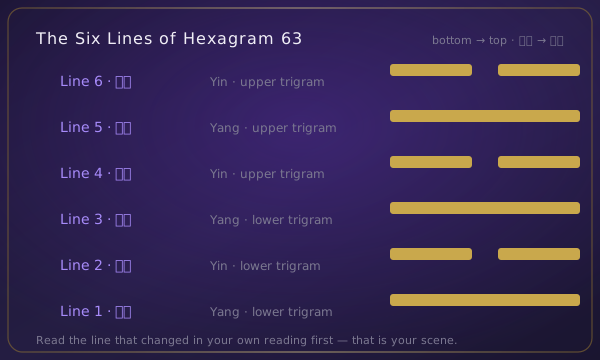
Each line of Hexagram 63 is one scene in the life of a completed thing — how it is crossed, how it is kept, and how it is lost.
Line 1 (初九) — Drag the wheels, wet the tail; no blame. The scene: crossing carefully at the end — braking the wheels, dipping the tail in the water but not the body. The modern reading: caution at the finish. The last stretch of any project, relationship, or investment is where overconfidence lives. This line says: slow the wheels at the crossing and you carry no blame.
Line 2 (六二) — The lady loses her carriage curtain; do not chase it — in seven days you get it back. The scene: a small loss during a journey, and the instruction to leave it. The modern reading: the hexagram's patience line. Small things go missing at completion stage — a detail, a document, an advantage — and chasing them costs more than losing them. The seven days is the cycle's clock: what is yours returns on its own schedule.
Line 3 (九三) — King Gaozong campaigned against Guifang; in three years he conquered it. Do not employ petty people. The scene: the long campaign that succeeded through patience and the right personnel. The modern reading: the hexagram's effort line. Real completion takes the time it takes — three years, not three months — and the named failure mode is staffing: petty people in charge of a long campaign is how completion turns into the disorder the judgment promised.
Line 4 (六四) — The boat has rags for repairs; vigilance all day. The scene: a boat crossing with nothing but rags to plug the leaks, watched constantly. The modern reading: the maintenance line, and the hexagram's heart. Every working system has its rags — the workaround, the temporary fix, the person holding it together. Vigilance all day (终日戒) is what keeps the rags working. The day you stop watching the rags is the day the boat takes water.
Line 5 (九五) — The eastern neighbor kills an ox; the western neighbor's simple spring offering truly receives the blessing. The scene: two neighbors, two sacrifices — the lavish and the sincere. The modern reading: the hexagram's values line. After completion, substance beats spectacle: the honest small act outweighs the impressive large one. This is the line for anyone who has started performing success instead of maintaining it.
Line 6 (上六) — Wetting the head; danger. The scene: the fox that crossed the river safely and then, at the far bank, dipped its head in the water. The modern reading: the hexagram's catastrophe line, and the reason its judgment says 终乱. Overconfidence at the completed stage — the victory lap, the stopped watching, the "we're past that now" — is how finished things fail. The line is one word long in the classical text: danger.
When all six lines change: Hexagram 63 inverts into Hexagram 64 — completion fully exhausted becomes before completion. The finished thing, watched to its natural end, hands the cycle back to the unfinished.
How to Read Hexagram 63 with the Number Oracle
Hexagram 63 reaches you the same way every hexagram does: through three numbers that arise naturally while you hold your question. The first number sets the upper trigram, the second the lower trigram, and the third identifies the changing line. Enter your three numbers and your question at numbers-oracle.com and you will get the hexagram plus an AI interpretation written for your situation — free, no registration. For the mechanics, read how three numbers become a hexagram →
Your lucky energy for Hexagram 63: Fire element (the body trigram, fire below). Lucky colors are red and purple; the matching crystal is amethyst, traditionally associated with clarity of mind and calm.
Related hexagrams: Hexagram 64 (Before Completion) — its paired opposite and the cycle's restart; Hexagram 50 (The Cauldron) — refinement, the work that follows completion.
Hexagram 63: Common Questions
What does hexagram 63 mean in one sentence?
Hexagram 63 means a state is complete and working — every element in its correct place — and the whole task now is vigilant maintenance, because the hexagram promises disorder at the end of anything unwatched.
Is hexagram 63 a yes or no?
Hexagram 63 is a qualified yes: the work is done and the configuration is favorable, but its judgment limits success to small things (亨小) and warns that ends are where disorder lives. It favors maintaining and preparing, not launching anything new on completion momentum.
What should I do when I receive hexagram 63?
Check which line changed. Dragged wheels (line 1) means slow down at the finish; lost curtain (line 2) means let small losses go; three-year campaign (line 3) means staff the long work correctly; rags in the boat (line 4) means watch your patches daily; simple offering (line 5) means substance over spectacle; wet head (line 6) means the victory lap is the danger.
Why is hexagram 63 called "After Completion"?
Because it is the only hexagram in the I Ching where every line sits in its correct position — yin where yin belongs, yang where yang belongs. The crossing is finished; the system is in order; and the Book of Changes puts its warning about endings exactly here, one hexagram before the end.
Completion is not the end of the work. It is the moment the work becomes watching — and the day you stop watching is the day disorder starts.