I Ching Hexagram 64 (Before Completion): Meaning in Love, Career and Life
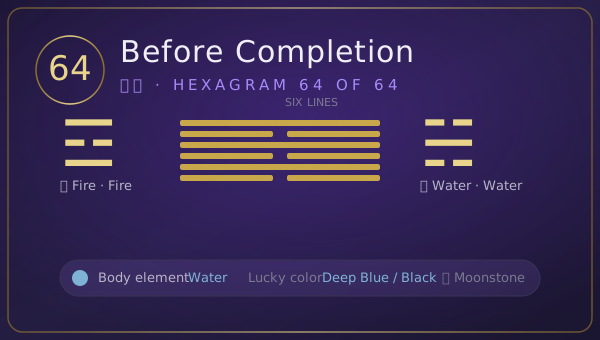
Hexagram 64 is the final hexagram of the I Ching: fire above, water below — the two elements present but not yet in their working arrangement. Its classical judgment reads "success; the little fox has almost crossed, but wets its tail — nothing is beneficial" (未济:亨。小狐汔济,濡其尾,无攸利), and its image is fire over water, which the text says means the noble person "carefully distinguishes things and gives each its proper place." When Hexagram 64 appears in a reading, it marks the last stretch — the unfinished thing that is still moving, and the Book of Changes' final lesson about how things actually end.
The Story of Hexagram 64: The Fox on the Ice
A young fox comes to a frozen river. The crossing is almost done — the far bank is right there — and then the tail dips in. The ice is thinner than it looked, the weight shifted, and the fox turns back. That image is the hexagram's own opening line: 小狐汔济,濡其尾,无攸利 — "the little fox has nearly crossed, wets its tail, and there is nothing beneficial in it." The I Ching ends with this picture deliberately. Not with triumph, not with a god, not with the completed work — but with the almost. Because the system's final claim is that nothing is ever fully finished: the 64th hexagram's elements are fire over water, both present, neither working yet, and the cycle hands itself back to the first hexagram the moment it ends. The Book of Changes does not conclude. It loops.
What Is Hexagram 64?
- Name: 未济 (Weiji), traditionally rendered Before Completion; also translated as Not Yet Crossed, Not Yet Completed, or The End Approaches
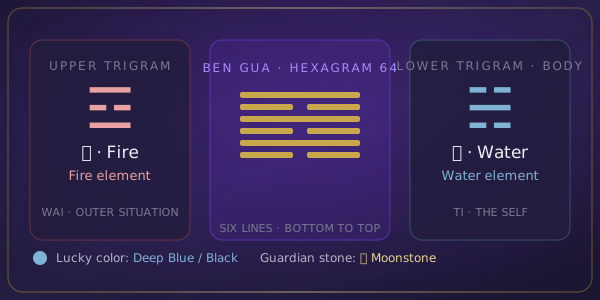
- Structure: Fire over Water — all six lines out of position: yin where yang belongs and yang where yin belongs
- Position: 64 of 64, the final hexagram, the exact inversion of Hexagram 63 (After Completion)
- Element: Water on the body trigram — the lower trigram (water) belongs to Water; fire above belongs to Fire
- Body trigram: the lower trigram (water), which in plum blossom divination represents the self
- Core images: the fox on the ice, the unboiled kettle, the unfinished crossing, the last mile, the loop back to the beginning
The Core Meaning of Hexagram 64
The classical judgment of Hexagram 64 reads: 未济:亨。小狐汔济,濡其尾,无攸利 — "Success. The little fox has almost crossed and wets its tail; nothing is beneficial." The judgment contains both a promise and a picture of failure, and the order matters: success is stated first, then the fox.
Three things this hexagram is telling you, each standing on its own:
Unfinished is not failed — it is the natural state. Every line of Hexagram 64 is out of position, and yet the judgment opens with 亨, success. The hexagram's claim is structural: a situation in progress, correctly handled, succeeds — because progress is what reality actually looks like. The completed hexagram (63) is the rare configuration, not the default. You live in 64 more often than 63.
The danger is concentrated at the end. The fox did not fail in the middle of the river. It failed near the bank, where vigilance relaxes. The hexagram's whole architecture is a warning about final stretches: the last negotiation, the final mile of the project, the last conversation before the commitment. The tail gets wet at the end because that is where the weight shifts.
The elements must be put in their proper places. The image text — 慎辨物居方, "carefully distinguish things and settle each in its place" — is the hexagram's method. Since nothing is yet in position, the task is placement: which element goes where, who does what, what order things happen in. Completion is not forced in Hexagram 64; it is arranged.
The end loops back to the beginning. The 64th hexagram is the last, and the Book of Changes hands straight back to Hexagram 1 — the creative source. The system's final teaching is that completion is a rest stop, not a terminus. What you finish becomes the raw material of what starts next.
The question Hexagram 64 answers is not "will I make it?" It is: what is still out of place, and am I being careful exactly where the fox gets wet?
Hexagram 64 in Love and Relationships
If you are single: Hexagram 64 describes the almost — the connection that keeps not quite happening, the person you keep circling, the timing that keeps slipping. The hexagram's counsel is not to force the crossing (征凶 — rushing is ominous, line 3) but to arrange the elements correctly: clarity about what you want, honesty about where things actually stand, and patience with a process that is genuinely unfinished.
In an early or uncertain stage: This is the pre-definition hexagram — the stage before the label, where both people are still deciding. The hexagram says this stage is workable (亨) but it punishes two specific errors: rushing to close it (the wet tail), and letting it drift with no placement at all. The hexagram's image text is the practice for this stage: carefully distinguish what this is, and give it its proper place.
In a stable relationship: Hexagram 64 in a stable relationship usually means a chapter is closing and the next one has not been named — the post-move adjustment, the after-children phase, the post-conflict rebuild. The hexagram's counsel is placement: figure out what each person is now to the other, rather than assuming the old arrangement still holds. Line 5's "the noble one's radiance" (君子之光) is the hexagram's picture of what a relationship looks like when the arrangement is finally honest.
In a crisis: If the relationship is stuck in almost — almost breaking up, almost repairing, almost talking about it — Hexagram 64 names the pattern exactly. The fox is in the river, tail wet, unable to move forward or back. The hexagram's way out is not intensity; it is placement: one true conversation that gives the situation its proper place, even if the place turns out to be the end.
Hexagram 64 in Career, Money and Decisions
Career: This is the last-mile hexagram — the project at 90%, the launch with the final bugs, the promotion not yet announced, the business that has revenue but not yet profit. The hexagram's judgment opens with success, which is its claim that almost-done work, correctly finished, completes. Its warning is aimed at the finish: the fox wets its tail at the bank, meaning teams lose projects at the last mile more than anywhere else — the patch shipped untested, the launch date moved, the scope that crept back in. The hexagram's method: distinguish carefully, place each thing correctly, and do not confuse momentum with completion.
Money: Hexagram 64 is the pre-completion financial hexagram — the raise not yet signed, the deal in diligence, the savings goal not quite reached. It favors finishing what is funded over starting what is not (征凶 — advancing now is ominous), and it favors arrangement over force: get the terms in their proper places before crossing. The hexagram's line 4 is a patience story — the three-year campaign rewarded — and line 6 is the celebration warning: the drinking and confidence at the end are fine, until the tail and head both go under.
Decision: Hexagram 64 says: finish this one. Do not start the next crossing while the current fox is still in the river. If the decision is about whether to push through the last stretch, the hexagram is favorable (亨) with the condition of care exactly where care is hardest — the end. If the decision is about launching something new on top of something unfinished, the hexagram's fox is the answer.
The Changing Lines of Hexagram 64: Six Scenes
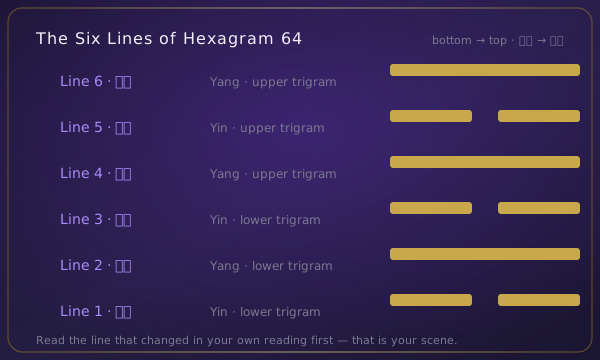
Each line of Hexagram 64 is one scene in the last stretch — how the almost fails, and how it finishes.
Line 1 (初六) — Wets the tail; regret. The scene: the fox at the very start of the crossing, tail already in the water. The modern reading: the earliest warning of the hexagram, placed at the beginning. Something about this crossing is wrong from the start — the timing, the footing, the preparation — and the tail getting wet now is the signal. Regret at line 1 is cheap; it is the signal, not the verdict.
Line 2 (九二) — Drag the wheels; perseverance brings good fortune. The scene: braking the cart at the water's edge, refusing to rush the crossing. The modern reading: the hexagram's central practice. Slow the wheels at the last stretch — check the patch, confirm the terms, have the conversation before the commitment. Perseverance here means the discipline to be careful when speed feels most justified.
Line 3 (六三) — Not yet crossed; advancing is ominous. Favorable to cross the great river. The scene: standing at the river, the far bank visible, and the judgment that charging in now is ominous — while the crossing itself remains favorable. The modern reading: the hexagram's most precise line. The destination is right; the timing is not. Cross, but cross prepared. Advancing raw into the last stretch is what wets the tail.
Line 4 (九四) — Perseverance brings good fortune, regret disappears. The thunder campaign against Guifang: in three years, rewarded by the great state. The scene: the long campaign that finished correctly and was rewarded. The modern reading: the hexagram's effort line, and its promise. What is unfinished can be finished — on the campaign's schedule, not the impatience's. Three years, then the reward. This is the line for anyone holding a long unfinished thing together.
Line 5 (六五) — Perseverance brings good fortune, no regret. The noble one's radiance; with sincerity, good fortune. The scene: the person whose correctness becomes visible at the end. The modern reading: the hexagram's center line. Finish with integrity and the result shines — 君子之光. Sincerity (有孚) at this stage is what separates a completion that holds from one that collapses after the applause.
Line 6 (上九) — There is confidence in drinking; no blame. But wetted tail, wetted head — danger. The scene: the fox almost across, celebrating with genuine confidence — and then both tail and head go under. The modern reading: the hexagram's final warning, and the last line of the entire Book of Changes. The confidence is real and earned; the danger is that confidence moved the weight at the wrong moment. Celebrate after the bank, never in the river.
When all six lines change: Hexagram 64 inverts into Hexagram 63 — the unfinished, fully arranged and completed, becomes after completion. And the 64th hexagram, being the last, hands the whole cycle back to Hexagram 1: what you finish becomes the seed of what begins.
How to Read Hexagram 64 with the Number Oracle
Hexagram 64 reaches you the same way every hexagram does: through three numbers that arise naturally while you hold your question. The first number sets the upper trigram, the second the lower trigram, and the third identifies the changing line. Enter your three numbers and your question at numbers-oracle.com and you will get the hexagram plus an AI interpretation written for your situation — free, no registration. For the mechanics, read how three numbers become a hexagram →
Your lucky energy for Hexagram 64: Water element (the body trigram, water below). Lucky colors are deep blue and black; the matching crystal is moonstone, traditionally associated with intuition and emotional flow.
Related hexagrams: Hexagram 63 (After Completion) — its exact inversion and the state on the far bank; Hexagram 40 (Deliverance) — thunder over water, the crossing that gets made.
Hexagram 64: Common Questions
What does hexagram 64 mean in one sentence?
Hexagram 64 means something is unfinished but still moving — success is available, and the whole task is to arrange the last pieces correctly and be most careful exactly at the end.
Is hexagram 64 a yes or no?
Hexagram 64 is a conditional yes: its judgment opens with success (亨) for the work already in progress, but it warns that advancing raw at the last stretch is ominous (征凶) — finish carefully, and do not start a second crossing while the first fox is still in the river.
What should I do when I receive hexagram 64?
Check which line changed. Wet tail at the start (line 1) means re-check the footing; dragged wheels (line 2) means slow down at the end; not yet crossed (line 3) means the destination is right but the timing needs preparation; three-year campaign (line 4) means it finishes on the campaign's schedule; noble one's radiance (line 5) means finish with visible integrity; confidence and drinking (line 6) means celebrate only after the bank.
Why is hexagram 64 called "Before Completion"?
Because it is the 64th and final hexagram, with every line out of position — the exact opposite of Hexagram 63. The Book of Changes deliberately ends with the unfinished, because its final teaching is that nothing completes permanently, and what ends hands the cycle straight back to the beginning.
The river is never fully crossed. The fox that watches its tail at the bank is the one that gets to start the next spring.